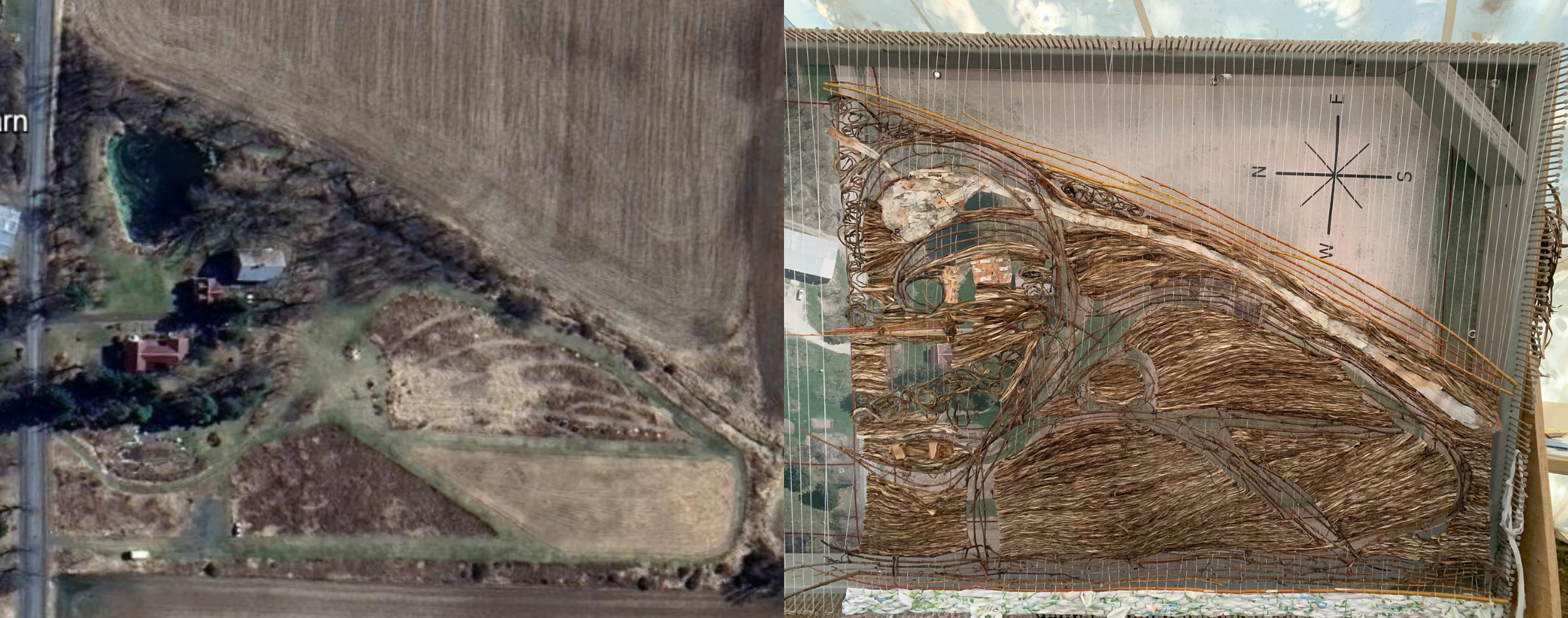
‘Weaving the Land’ Grant Project Reflections
‘Weaving the Land’ took me just over 2 months to weave, at an estimated 45 hours of active weaving of wet/soaked materials, and more hours spent harvesting the seven natural weft fibers from our trees, hedgerows, and gardens throughout the year.
This project was my first solo-arts grant, and my first attempt at something of this scale that intermingled so many different textile materials. It was also a process in accepting my grief, and growing into my identity as an artist.
My dream in submitting the grant to the Arts Council of the Southern Finger Lakes was to use this project as a vehicle by which to mend my relationship with the land I inherited after my father’s death in February of 2023. To find my own joy and purpose in the natural abundance of the property, and be less weighed down by the endless to-do’s of land stewardship, which include never-ending maintenance and caretaking of said natural abundance and overgrowth.
…and, I think I found it. I spent many weeks, and long evening hours seated in a canvas tent in our back yard, slowly teasing the natural materials with their uneven textures, thorns, twigs, and natural breakage along the corded warp threads of my loom. As I made my own artistic choices about ways to represent the pathways, gardens, and trees of the property that I had spent the last few years agonizing over the caretaking of I felt my fingers shift from the stiffness of responsibility into the caresses of care as I wove each section of the the land.
I was also able to rest more gently with memories of my father as the weaving progressed. Increasingly less burdened by the fear of his judgement that I wasn’t caring for his trees correctly, or had missed the window to mulch and turn the compost, and instead allowed myself to hear his love and pride that I was pursuing art for arts sake. He would have loved this project, and would have been impressed to see the map grow over the weeks I worked on it. The curves and undulations of the weaving representation of the land we shared for so many years a clear representation of the ways that he chose to plant, mow, prune, and design our gardens and fields so they might inspire creativity. I made some peace with being not just the daughter of a master woodworker, but also an artist in my own right. Making a creation just for its own sake, and not for any utility or planned usefulness.
I also had to make some peace with my own hubris, and increasing recognition of all I hadn’t known or considered in submitting the grant. When I wrote the grant in October 2024, fibers were in abundance, everywhere I looked there were materials to harvest. I was awarded the grant a few months later in February 2025, and had neglected to consider that the fibers I had been dreaming of only a few months before were now frozen and under winter decomposition in the snow, and wouldn’t be ready to harvest again until the following September. A project I had imagined to work methodically on over 9 months, was stalled for nearly 6, waiting the natural growth cycle of the plants. The loom and vinyl map ready by April, but the the fibers still in their growing season from March-September. I began weaving in earnest in September, which also put me in a race against a different seasonal change, the incoming chill of autumn. I did all my weaving outdoors, either in the yard, or in an unheated canvas tent, the weaving process produced consistent natural mulch beneath my feet as I clipped off sections, and tore off rotted ends of leaves. The loom also stood at over 6 feet, and I couldn’t imagine bringing it indoors. As the weeks progressed and October grew cooler, I knew I had to finish my weaving before the days sunk below freezing, or my hands wouldn’t be able to do the work. I managed just under the wire. Finishing the map the first weekend of November, tying off the threads, and freeing it from the loom, just as the first frosts were hitting our gardens, and the water in my materials bucket began to skim with ice overnight.
THE MATERIALS
wild grapevine (vitis vinifera), daylily leaves (hemerocallis spp.), willow (salix nigra), white birch bark (betula papyrifera), bittersweet (celastrus sp.), iris leaves (iris atropurpurea), locust root (gleditsia triacanthos); polyester kitestring cord (warp), cotton 3-strand cord (rope loops), iron (nails along back of locust root)
From the start I was committed to using only those materials that generations of humans have determined are “good” for weaving and manipulating. I didn’t use every natural weaving material available on the property. I didn’t keep the time to process dogsbane for cordage, I was nervous to process blackberry brambles and stinging nettles lest the impact on my hands delay too many days of weaving, and did not travel too deep into our woods. I harvested, pulled, and clipped those things that made themselves available, and also those things that the harvesting and cutting back of was part of my gardening/caretaking/stewarding/land management responsibilities. With working them through my hands, I came to know each item in its possibilities - not just as a plant I had seen grow wild, harvested, composted, or burned as a weed. Plants as friends that I was co-creating with.
——
The daylily leaves made up the bulk of our meadows, and proved to be a very responsive and joyful plant to work with. Twisting easily, holding their strength, and drying with a warm shine and luster. As I proceeded with over-under, over-under, over-under my mind was able to reflect on the land. To remember the harvests from our vegetable gardens, the flowers that grew in that corner, to think of the bees I had found by the maple tree that I was trying to depict with a twist of iris.
Wild grapevines made effective pathways and anchor points, helping me portion out sections of the property, and despite their many tendrils causing some frustration to ease up and around each support thread, the visual beauty they lent to the weaving, made me less angry at the mass of grapevines that I always mean to cut down before they strangle our trees.
White birch bark was thin and slippery, not easily staying in the sections I set for it, I anchored the pond layers of bark with rose thorns, but was far and away the most beautiful material to me to work with.
Irises are my favorite flower on the property. They always make me think of my mother, and grandmother. The lushness of their petals and how they glow in sun deeply embedded in my minds eye. Their petals however distengrated into fibers as I twisted them into tree forms. Behaving so dramatically different that the daylily leaves they looked so similar to when dry, and emulating none of the luster I had hoped for.
I quickly realized that I wouldn’t be able to master small intricacies at this scale, even with a 5ftx3ft map and loom to work off of, the gaps between warp threads were often an inch or more wide, not enough space to capture the details of buildings or individual trees when there might only be one to two warp threads to work around on it. I let go of some of my aspirations of depiction, and let myself ease into allowing the final piece to take form in the way that it wanted to. I thought a lot about being a “student” of this type of process. It was my first time. Mistakes were not only acceptable, they were expected.
With my mixing of materials I was able to mimic sections of the map in way that clearly translates when you see the weaving and the aerial map side by side. Daylily for large grass and meadow areas. Grapevine for walkways. Straight willow for the driveway and property border. Birch bark for the creek, pond, and also for the house and barn, irises twisted and swirled for the trees and hedgerows, one loan corn leaf for the vegetable garden, and bittersweet and locust added at the end to create a frame around the weaving, that rather than containing the project felt like it shares that this one section of land expands out beyond the borders I limited myself to.
I could reflect and reminisce on this premise, this project, the grief and responsibility in it forever. But as one of my teachers says at the end of each lesson, I’m going to tie up the bag here.